
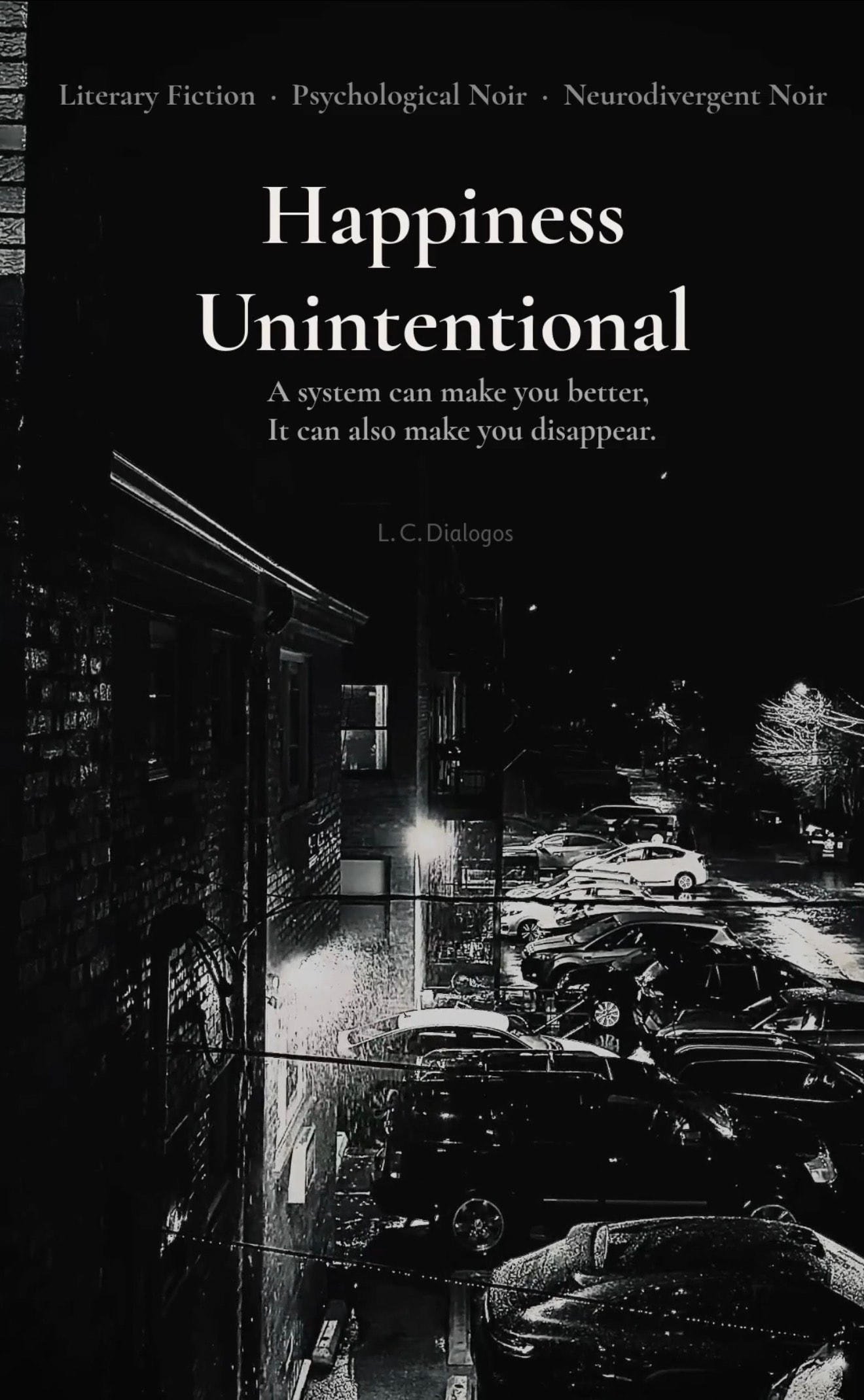
The ground gave way easier than he expected.
Wet soil collapsed beneath the shovel in heavy clumps, releasing the cold mineral smell of roots and rain rot. Alex worked methodically, the way he did everything — not because he was calm, but because the system required it. Panic was inefficient. Panic left evidence.
Sarah lay wrapped in the tarp beside him, impossibly still now.
He paused and looked out into the trees.
The woods did not care.
No judgment.
No revelation.
No moral clarity descending through the dark.
Just insects.
Wind.
Damp earth.
Procedure.
He realized, with quiet horror, that this was the calmest he had felt in months.
Three months earlier, Alex had been sitting in a conference room on the fourteenth floor of a building that smelled of recycled air and ambition, listening to a man named Derek explain the concept of "radical ownership."
Derek was the kind of person who had discovered self-help in his late twenties and now spoke about it the way converts speak about religion — with the particular intensity of someone who has recently been saved and cannot understand why everyone else is still drowning.
"The problem," Derek said, clicking to a slide that read ACCOUNTABILITY IS A GIFT, "is that most people are operating from a victim mindset. They're waiting for permission. They're waiting for someone to hand them their life."
Alex wrote the phrase "victim mindset" in his notebook and drew a small box around it. He had been doing this for eleven years — attending these sessions, taking notes, drawing boxes around the phrases that were supposed to change him. The boxes were a way of containing the phrases without having to absorb them. A quarantine system.
He was thirty-five years old. He had attended forty-seven professional development seminars, read two hundred and twelve self-help books, completed six online courses in emotional intelligence, and spent four years in therapy with a woman named Dr. Reyes who had eventually told him, gently but clearly, that she did not think she could help him further.
He had not told Sarah about Dr. Reyes.
He had not told Sarah about a lot of things.
The seminar was called "Unlocking Your Authentic Self: A Weekend Intensive for High Performers," and it had cost four hundred and fifty dollars, which Alex had paid himself because his company's professional development budget did not cover events that were not directly related to his job function, and because he had not wanted to explain to his manager why he needed to attend something called "Unlocking Your Authentic Self."
He had been attending events like this for eleven years.
He had been trying to unlock his authentic self for eleven years.
The lock, he was beginning to suspect, was not the problem.
"I want you to turn to the person next to you," Derek said, "and tell them one thing you've been avoiding."
The room shuffled into pairs. Alex turned to the woman on his left, a marketing director named Priya who had been taking notes on a rose-gold laptop and who now looked at him with the expression of someone who had agreed to a game without fully reading the rules.
"I'll go first," she said. "I've been avoiding having a difficult conversation with my business partner about the direction of the company."
She looked at him.
Alex looked at his notebook.
"I've been avoiding," he said carefully, "understanding what I actually feel."
Priya nodded in the way people nod when they are not sure if something is profound or concerning.
"That's really brave," she said.
Alex wrote "brave" in his notebook and drew a box around it.
He had met Sarah at a seminar like this one, three years earlier. She had been sitting two rows ahead of him at an event called "The Empathy Advantage: Building Authentic Connections in the Workplace," and she had turned around during a break to ask if he had a pen she could borrow, and he had given her his pen, and she had not given it back, and he had not asked for it, and somehow this had become the beginning of a relationship.
He had liked her immediately, which was unusual. He did not usually like people immediately. He usually needed time to build a model of a person — to map their patterns, predict their responses, understand the rules of engagement. Sarah had been different. She had been legible to him in a way that most people were not.
Later, he would understand that this was because she was performing, too.
But that came later.
"The authentic self," Derek was saying, "is not something you find. It's something you build. Every choice you make is either moving you toward your authentic self or away from it. Every relationship, every habit, every thought pattern — these are either aligned with who you truly are, or they're noise."
Alex wrote "noise" in his notebook.
He did not draw a box around it.
He was thirty-five years old and he had spent his entire adult life trying to reduce the noise, and the noise had not reduced. It had, if anything, gotten louder. More specific. More insistent.
The noise said: you are doing this wrong.
The noise said: everyone else knows something you don't.
The noise said: you have been performing a version of yourself for so long that you no longer know which parts are performance and which parts are real, and the performance is getting harder to maintain, and one day it will stop working entirely, and then what.
He had been diagnosed at thirty-four.
Not with anything dramatic. Not with anything that explained the previous thirty-four years in a single clarifying moment. Just: autistic. AuDHD. A neurodevelopmental profile that meant his brain had been running a different operating system all along, and every self-help book, every seminar, every therapy session had been written for a different machine.
He had sat in the neuropsychologist's office and listened to her explain this, and he had felt something he could not name. Not relief, exactly. Not grief. Something in between. Something that did not have a word in the self-help vocabulary he had spent eleven years accumulating.
He had gone home and told Sarah.
She had said: "That explains a lot."
He had not known, at the time, whether she meant it kindly.
The seminar broke for lunch at twelve-thirty. Alex ate a sandwich alone in a corner of the hotel lobby, reading a book about habit formation that he had already read twice. He was not reading it for new information. He was reading it because reading was easier than sitting with nothing to do, and sitting with nothing to do was easier than talking to the other attendees, and talking to the other attendees was easier than going home.
He did not want to go home.
This was new.
For most of his adult life, home had been the place where the performance could stop. The place where he did not have to maintain the version of himself that other people could understand. But in the past year, home had become a place where a different kind of performance was required — one he was less practiced at, one with rules he could not map, one where the stakes felt higher and the feedback was less legible.
Sarah had started using a phrase he did not understand: "I need you to be present."
He was present. He was always present. He was so present that the presence was exhausting — every sensory input catalogued, every social cue analyzed, every word weighed before it was spoken. He was the most present person he knew. He just could not show it in the way she needed him to show it.
He had tried to explain this.
She had said: "That's not what I mean."
He had said: "I know. I'm trying to understand what you mean."
She had said: "That's the problem. You're always trying to understand. You never just feel."
He had written this in his notebook later, in the bathroom, with the door locked.
He had drawn a box around it.
He had not known what to do with it.
Back in the woods, the hole was deep enough.
He set down the shovel and looked at Sarah's shape in the tarp. The tarp was blue, which seemed wrong — too bright, too ordinary. He had not planned this. He had not planned any of it. He had spent his entire adult life planning, and the one thing he had not planned for was this.
He had not planned for the moment when the performance stopped working.
He had not planned for what was underneath.
He had not planned for the particular quality of silence that follows a thing you cannot take back.
The woods were very quiet.
He picked up the shovel.
He kept working.