
Media Resources
Press & Media Kit
Everything you need to cover Happiness Unintentional.
One-Sheet
Logline
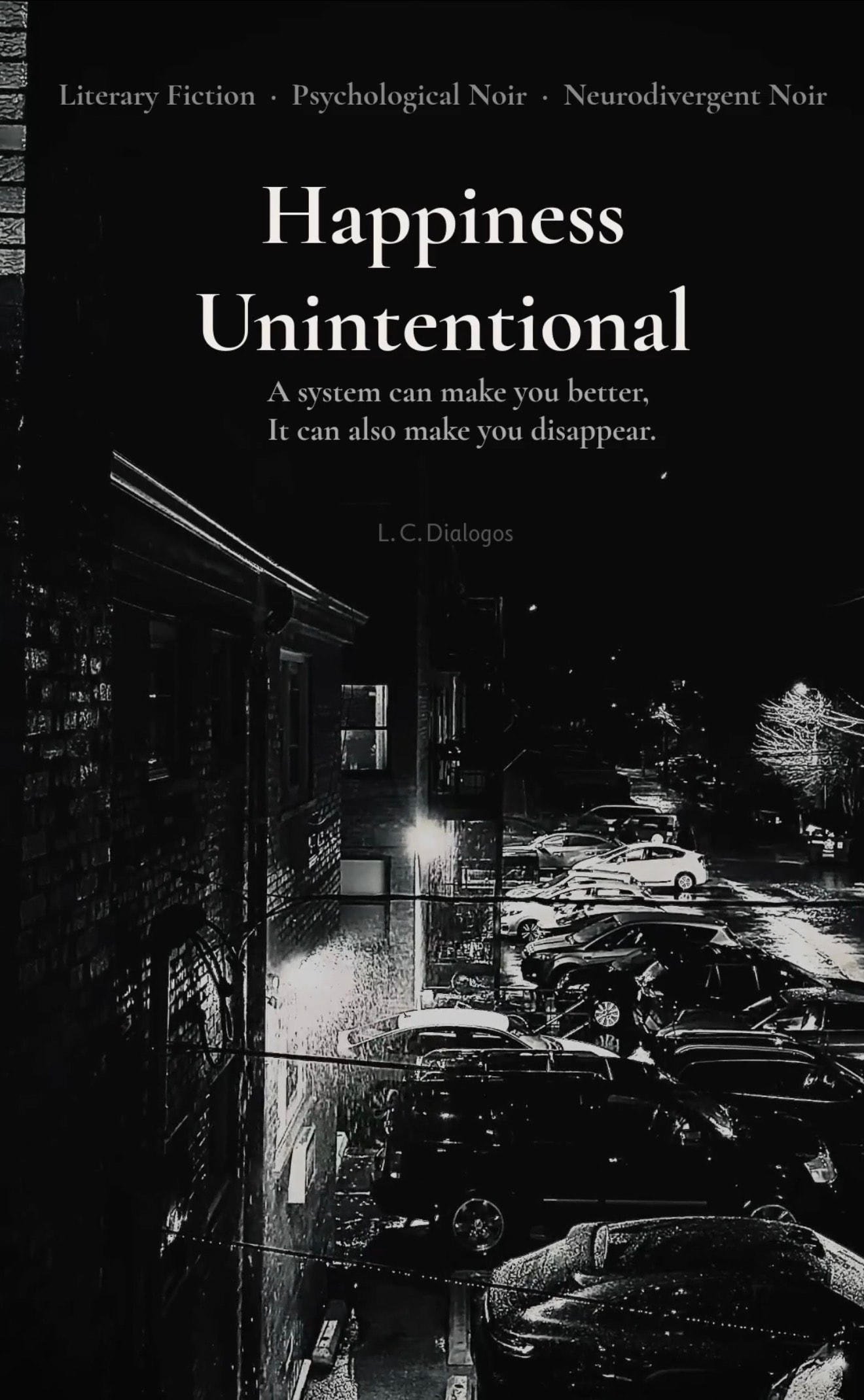
A noir about masking, exploitation, and the particular cruelty of a self-help book that was never written for a mind like his.
Book Description
Short (100 words)
Alex Breisburg didn't see it coming. He never does — the diagnosis came thirty years too late to help him read a room. So when a fight about money ends with his wife on the kitchen floor, he has no idea what to call what just happened.
Happiness Unintentional is a debut literary noir about masking, exploitation, and the particular cruelty of a self-help book that was never written for a mind like his.
Full Description
Alex Breisburg didn't see it coming. He never does — the diagnosis came thirty years too late to help him read a room. So when a fight about money ends with his wife on the kitchen floor, he has no idea what to call what just happened. An accident. A confession. The first entry in a ledger that won't stop growing.
His best friend knows a guy. The guy knows a woman named J.P. — sharp, expensive, and very good at turning a favor into a lifetime subscription. Her price escalates. So does what she is.
By the time Alex understands what he's become, he's lost whole days to the bottle, is missing memories he doesn't trust, and has done something he can't undo. There is no clean ending waiting for him. There is only the next person willing to explain, patiently, exactly what he owes.
What makes it unusual: the interiority isn't explained from outside — it's transmitted. Synesthesia, dissociation, and masking aren't described as case-study features; they're the texture of every sentence. Readers who've never experienced an AuDHD mind tend to finish this book having felt one from the inside, not read an account of one.
For readers of A Little Life, Convenience Store Woman, and Notes on an Execution. Includes a Reader's Companion with clinical context, a glossary, and community resources.
Author Bio
Short Bio (50 words)
L. C. Dialogos is the debut author of Happiness Unintentional — a literary noir about masking, exploitation, and the particular cruelty of a self-help book never written for a mind like his. Buddhist chaplain, speaker, and educator. Their work examines identity as something constructed, rehearsed, and perpetually unstable.
Full Bio
L. C. Dialogos writes dark psychological fiction exploring identity crisis, emotional numbness, and the anxiety of performing a self you're no longer sure exists.
Influenced by the body horror and psychological destabilization of David Cronenberg, the surreal dissociative logic of David Lynch, and interdisciplinary frameworks spanning anthropology, sociology, biology, neurology, and experimental literature, Dialogos' work examines human behavior as both adaptive machinery and existential fracture.
Their fiction centers neurodivergent cognition, sensory realism, procedural emotionality, and the tension between performance and authenticity. Rather than approaching psychology through conventional therapeutic narratives, Dialogos treats identity as something constructed, rehearsed, inherited, biologically constrained, and perpetually unstable.
Mx. Love C. Dialogos is also a Buddhist chaplain, speaker, educator, and Licensed Marriage and Family Therapist. Their clinical writing has appeared in Psychotherapy Networker (September/October 2026).
See the Book
A visual introduction to Happiness Unintentional — suitable for embedding or sharing.
Direct link: youtu.be/JFmz8WL7XxU
In the author's words
Why I wrote this book — and why the protagonist is AuDHD.
Direct link: youtube.com/watch?v=IHtHqHexApQ
Interview Angles
What does "masking" mean, and why does fiction explore it better than self-help?
Masking is the learned suppression of neurodivergent traits to pass as neurotypical. Fiction can hold the interiority of that experience — the exhaustion, the dissociation, the grief — in a way a checklist cannot.
The novel is described as psychological noir. What does that mean for a book about identity?
Noir is about a world where the system is rigged and the protagonist knows it but keeps moving anyway. For Alex, the rigged system is his own cognition — and the crime is what optimization costs.
How does your background as a therapist and Buddhist chaplain shape the fiction?
It means I can write suffering without pathologizing it. The Reader's Companion at the end of the novel is clinical and generous — it names what Alex experiences and points toward community.
Who is this book for?
Anyone who has ever performed a version of themselves so long they forgot there was another one underneath. Readers of A Little Life, Convenience Store Woman, Notes on an Execution.
What do you want readers to feel when they finish?
Caught. Seen. And then — because of the Companion — less alone.
Key Quotes
"A system can make you better. It can also make you disappear."
— Alex, Chapter Two
"He realized, with quiet horror, that this was the calmest he had felt in months."
— Chapter One — Opening Scene
"I had optimized myself into a kind of functional isolation: administratively survivable, but emotionally unreachable."
— Alex, Chapter Three
"The woods did not care. No judgment. No revelation. No moral clarity descending through the dark."
— Chapter One
Early Readers
"Anyone who's masked their way through a workplace, a marriage, a dinner party will feel a specific chill of recognition here. The Reader's Companion at the end surprised me — closing a psychological noir with a plainspoken glossary and a list of real resources reframes the whole thing as something almost tender."
— Lauren · 5 stars · Verified Purchase · Amazon
"Dialogos has an eye for the small mechanical detail of social performance that I haven't seen rendered this exactly before. As someone who recognized more of myself in Alex than I'm comfortable admitting, I found whole pages that read like being caught."
— Verified Purchase · Amazon
Reviews updated as they come in. For advance review copies, contact LC@lovedialogos.com.
Press Contact
Mx. Love C. Dialogos
For review copies, interview requests, feature pitches, podcast bookings, or any press inquiries, please reach out directly. Response time is typically within 48 hours.
LC@lovedialogos.com