Psychological noir is not about crime. It is about the architecture of a mind under pressure: and the specific dread of watching it fail. Here is what defines the genre.
.png)
What Is Psychological Noir: And Why It Gets Under Your Skin
Classic noir has a body. Someone is dead, or someone is going to be. There is a detective, a femme fatale, a city that is wet and morally compromised. The darkness is external: it lives in the streets, in the corruption, in the crime.
Psychological noir moves the darkness inside.
The Shift Inward
In psychological noir, the threat is not a killer or a conspiracy. It is the protagonist's own mind, its distortions, its blind spots, its capacity for self-deception. The crime, if there is one, is often secondary to the question of whether the person investigating it can be trusted as a narrator of their own experience.
The genre is interested in unreliability. Not the cheap kind, where the twist reveals that the narrator was lying to you. The expensive kind, where the narrator is lying to themselves, and you watch it happen in real time, with growing unease, because you recognize the mechanism.
The Atmosphere Is the Point
Noir has always been as much about atmosphere as plot. The rain, the shadows, the cigarette smoke, these are not decorative. They are the externalization of an internal state. The world looks the way the protagonist feels.
Psychological noir inherits this, but the atmosphere becomes more abstract. It is not rain on a window. It is the specific quality of dread that comes from watching someone optimize their way into a corner. It is the silence between what a character says and what they mean. It is the feeling that something is wrong before you can name what it is.
The best psychological noir makes you feel the wrongness before you understand it. By the time you understand it, you are already inside it.
The Influences
The genre has roots in multiple traditions.
Hardboiled fiction gave it the stripped-down prose and the moral ambiguity. Chandler and Hammett established that the detective could be as compromised as the world he was investigating.
European literary modernism gave it the interior monologue and the fractured self. Kafka's protagonists are psychological noir protagonists, men caught in systems they cannot understand, whose attempts to move through those systems reveal the systems to be internal as much as external.
Film noir gave it the visual grammar: the chiaroscuro, the shadow, the face that is half-lit and half-hidden. Directors like Hitchcock and later Lynch showed that the most disturbing thing you can put on screen is not violence but wrongness, the sense that the world is slightly off in a way that cannot be corrected.
Contemporary literary fiction has absorbed all of this and pushed it further. Writers like Paul Tremblay, Ottessa Moshfegh, and Kazuo Ishiguro work in territory that is recognizably noir in its atmosphere and concerns, even when it does not look like genre fiction from the outside.
Essays like this, in your inbox
New writing on neurodivergent experience, dark fiction, and the book — no noise.
What Makes It Literary
The distinction between genre psychological thriller and literary psychological noir is not always clean, but it is real.
Genre thriller uses psychological instability as a plot mechanism. The unreliable narrator is a device for generating suspense and delivering a twist. The reader is meant to be surprised.
Literary noir uses psychological instability as a subject. The unreliable narrator is not a trick, it is the point. The reader is meant to be implicated. The discomfort is not resolved by a revelation; it is deepened by one.
Literary noir is interested in the texture of consciousness under pressure. It wants to know what it feels like from the inside to be a person who is coming apart, not what it looks like from the outside, and not how it ends, but what it is like to be there, in the middle of it, not yet knowing that it is happening.
Why It Endures
Psychological noir endures because it addresses something that other genres do not: the specific terror of not being able to trust your own perception of reality.
This is not an abstract fear. It is the fear of the person who has been gaslit into doubting their own experience. It is the fear of the person whose mental health is deteriorating and who cannot tell whether the world is getting worse or they are. It is the fear of the person who has performed a version of themselves for so long that they no longer know what is real.
These are not niche experiences. They are human ones.
Where Happiness Unintentional Sits
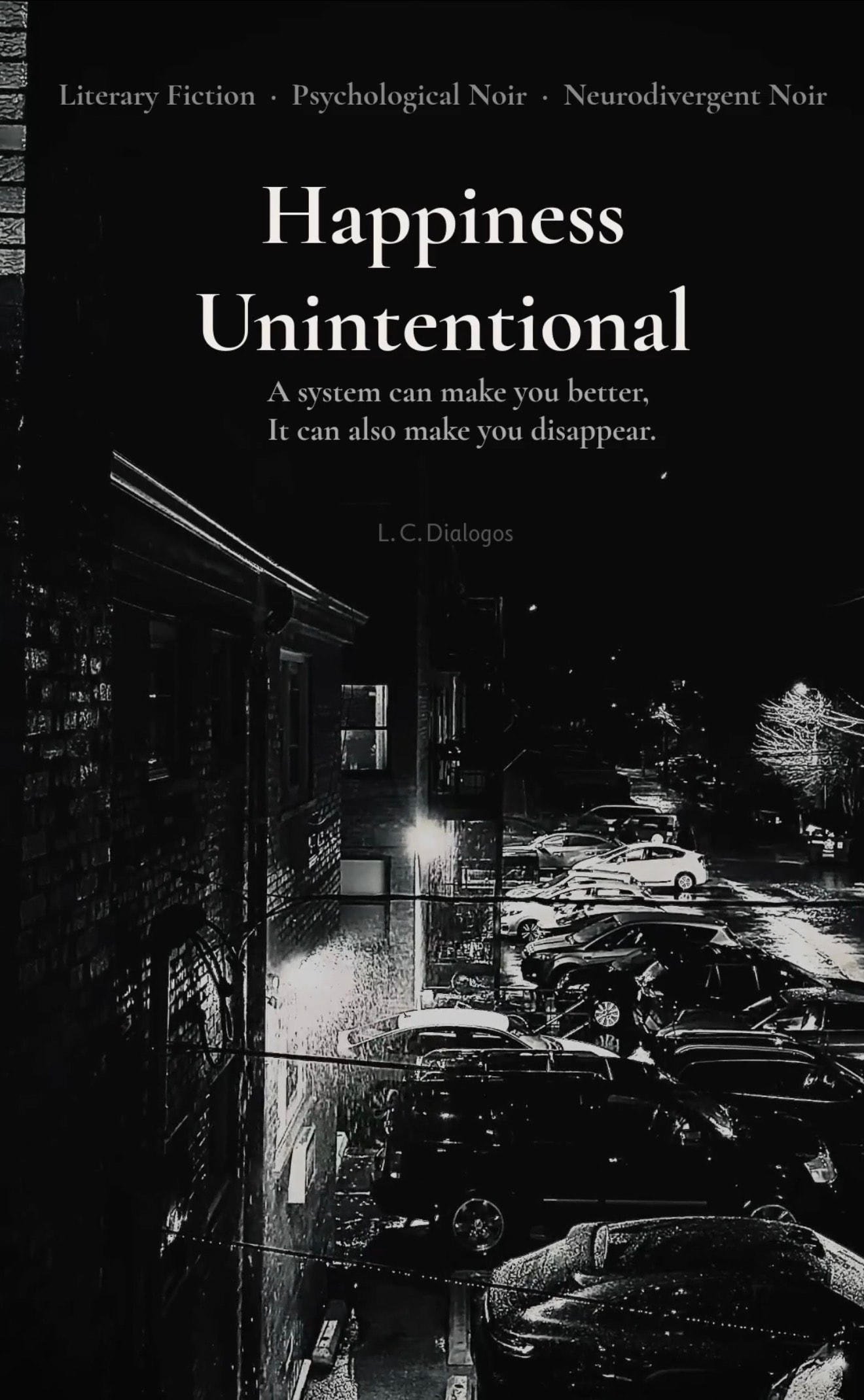
Happiness Unintentional is a psychological noir in the literary tradition. There is no crime. There is no detective. There is a man who has built a very precise system for managing his life, and the novel is the story of that system failing, slowly, then all at once.
The dread is not external. It is the dread of watching someone lose access to themselves. Of watching the optimization become the only thing left, and then watching that fail too.
If you have read Ishiguro's The Remains of the Day and felt the specific horror of a man who cannot see what is obvious to everyone else, you are in the right neighborhood.
Read the opening pages of Happiness Unintentional, or get the book in print, ebook, or Kindle.
Further reading from the Journal:
Explore Topics
Written by
L. C. Dialogos
L. C. Dialogos writes dark psychological fiction exploring identity crisis, emotional numbness, and the anxiety of performing a self you're no longer sure exists. Influenced by Cronenberg, Lynch, and interdisciplinary frameworks spanning anthropology, neurology, and experimental literature. About the author →