Not horror. Not thriller. Something harder to name: novels that get under your skin and do not leave. A reading list for people who want fiction that costs something.
.png)
8 Dark Literary Fiction Books That Stay With You
There is a category of book that is not horror, not thriller, not literary fiction in the comfortable sense. It is something harder to name. The darkness in these books is not external, it is structural, atmospheric, psychological. It lives in the prose itself, in the gaps between what characters say and what they mean, in the slow accumulation of wrongness that you feel before you can articulate it.
These are books that cost something to read. They are worth it.
1. The Remains of the Day: Kazuo Ishiguro
The most devastating novel about self-deception ever written, disguised as a quiet story about a butler taking a road trip. Stevens has spent his entire life in service to a man who turned out to be a fascist sympathizer, and he has organized his entire identity around the idea that this was noble. The horror is not in any single revelation. It is in watching a man who cannot see what is obvious to everyone else, including the reader, and understanding, slowly, that he will never see it.
Ishiguro does not raise his voice. He does not need to.
2. My Year of Rest and Relaxation: Ottessa Moshfegh
A wealthy, beautiful, recently orphaned young woman in New York decides to spend a year sedated. The novel is narrated in a voice of such flat, precise contempt, for herself, for the people around her, for the culture she is embedded in, that it becomes its own kind of horror. Moshfegh is interested in the specific texture of dissociation, of a person who has opted out of feeling as a survival strategy. It is uncomfortable in the best way.
3. Never Let Me Go: Kazuo Ishiguro
Ishiguro again, because he belongs on this list twice. A boarding school story that reveals itself, gradually and without drama, to be something much darker. The horror is in the acceptance, in the way the characters have internalized the terms of their existence so completely that they cannot imagine resistance. The novel is about complicity, about the stories we tell ourselves to make the unacceptable livable.
4. The Vegetarian: Han Kang
A woman in South Korea decides to stop eating meat. This decision, and the violence of the response it provokes from her family and husband, becomes the engine of a novel about bodily autonomy, the performance of femininity, and the specific madness of a world that cannot tolerate a woman who refuses to comply. Han Kang writes the body as a site of resistance and destruction simultaneously. It is not a comfortable book. It is a necessary one.
Essays like this, in your inbox
New writing on neurodivergent experience, dark fiction, and the book — no noise.
5. Tender Is the Flesh: Agustina Bazterrica
A novel set in a world where a virus has made animal meat toxic, and the solution has been to legalize the farming of humans for consumption. The horror is not in the premise, it is in the bureaucratic normalcy with which the premise is inhabited. The protagonist works in the industry. He is not a monster. He is a person who has adapted to the unthinkable, and the novel is interested in what that adaptation costs. Deeply disturbing, and deeply serious.
6. The Secret History: Donna Tartt
A group of classics students at a small Vermont college commit a murder. You know this from the first page. The novel is not a whodunit, it is a study of how intelligent people construct elaborate moral frameworks to justify what they want to do, and what happens when those frameworks collapse. Tartt is interested in beauty and corruption as inseparable, in the specific seductiveness of a world that has opted out of ordinary moral constraints.
7. House of Leaves: Mark Z. Danielewski
A house that is larger on the inside than the outside. A documentary about that house. A manuscript about that documentary. A footnote apparatus that may or may not be reliable. House of Leaves is formally experimental in ways that serve the content: the novel is about the experience of something being wrong in a way that cannot be measured or explained, and the form enacts that experience. It is also, underneath the apparatus, a genuinely terrifying story about a family coming apart.
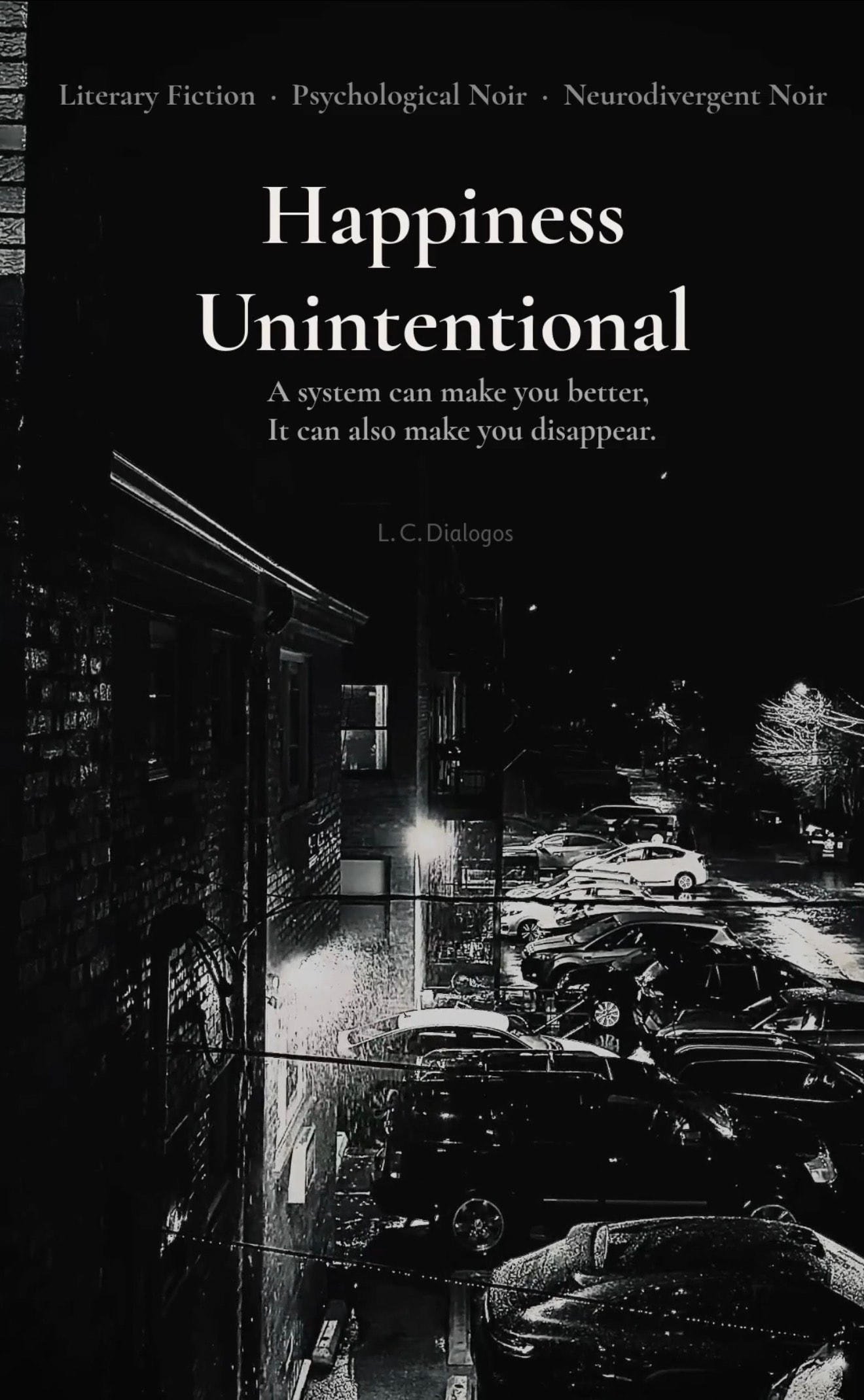
8. Happiness Unintentional: L. C. Dialogos
A man who has optimized his life into something that looks, from the outside, like success. A system for managing everything, output, relationships, emotional response, that is beginning to fail. A novel about the specific terror of losing access to yourself, written in prose that is precise and cold and occasionally beautiful in the way that very controlled things are beautiful just before they break.
This is the book this list was built around. If the others resonated, this one will too.
Read the opening pages of Happiness Unintentional, or get the book in print, ebook, or Kindle.
Further reading from the Journal:
Explore Topics
Written by
L. C. Dialogos
L. C. Dialogos writes dark psychological fiction exploring identity crisis, emotional numbness, and the anxiety of performing a self you're no longer sure exists. Influenced by Cronenberg, Lynch, and interdisciplinary frameworks spanning anthropology, neurology, and experimental literature. About the author →