A curated list of dark literary fiction that resonates with autistic readers: books that understand interiority, sensory overwhelm, and the exhaustion of performing normalcy.
.png)
The Best Dark Fiction for Autistic Adults
Most book lists for autistic readers focus on representation: characters who are explicitly autistic, stories that explain the diagnosis, narratives that end in acceptance and self-understanding. These lists have their place.
This is not one of those lists.
This is a list of dark literary fiction that resonates with autistic adults not because it names the experience, but because it renders it, the texture of a mind that processes differently, the specific exhaustion of social performance, the dread of a world that was not built for you and does not know it.
These are books that autistic readers tend to find and then press into other people's hands without being able to fully explain why.
The Remains of the Day: Kazuo Ishiguro
Stevens, the butler at the center of this novel, has optimized himself so completely for his role that he has lost access to his own interior life. He cannot name what he feels. He cannot recognize what he has sacrificed. He processes the world through the lens of professional duty so thoroughly that the personal has become inaccessible.
For autistic readers who have spent years masking, performing a version of themselves that is acceptable to the world, the recognition is immediate and uncomfortable. Stevens is not coded as autistic. He does not need to be. The mechanism is the same.
The novel's particular horror is that Stevens is not unhappy in any way he can identify. He has succeeded at the performance. The cost of that success is the entire book.
Convenience Store Woman: Sayaka Murata
Keiko has found the one environment where she functions perfectly: a convenience store, with its precise rules, its predictable rhythms, its clear expectations. Outside the store, the social world is incomprehensible. Inside it, she is competent, purposeful, and at peace.
The novel is funny and strange and deeply unsettling, because it refuses to pathologize Keiko's experience while also refusing to pretend that the world's demands on her are reasonable. The pressure she faces, to be normal, to want normal things, to perform normalcy convincingly, is rendered with precision.
Autistic readers often describe this book as the most accurate depiction of their experience they have ever encountered, despite the fact that the word "autism" never appears.
My Year of Rest and Relaxation: Ottessa Moshfegh
The narrator of this novel is trying to disappear. She has every external marker of a successful life and finds all of it unbearable. She is not depressed in any way she can articulate. She is simply done, with the performance, with the effort, with the requirement to be present in a world that demands constant social legibility.
The book is not about autism. But the specific quality of the narrator's exhaustion, the way social interaction costs her something she cannot name, the way she experiences her own emotions as distant and theoretical, resonates with autistic readers who have experienced burnout.
This is a book about what happens when the performance becomes unsustainable. It does not offer resolution. It offers company.
Never Let Me Go: Kazuo Ishiguro
Essays like this, in your inbox
New writing on neurodivergent experience, dark fiction, and the book — no noise.
Kathy, the narrator, describes her life with a flatness that is both protective and devastating. She processes her circumstances, which are genuinely horrific, with a calm that reads as dissociation, or as the particular kind of emotional management that comes from having no other option.
The novel is about people who have been told, implicitly and explicitly, that their inner lives do not fully count. Who have internalized that message so thoroughly that they do not rebel against it. Who find meaning and connection within the constraints of a world that has decided their value in advance.
For autistic readers who have spent their lives being told that their way of being is wrong, the resonance is not metaphorical. It is structural.
The Bell Jar: Sylvia Plath
Esther Greenwood's breakdown is, among other things, a breakdown of the performance. She has been performing competence, ambition, femininity, and social ease for so long that the machinery has seized. The novel is the story of what happens when the mask stops working.
The Bell Jar is not a comfortable book. It is not meant to be. But for autistic readers who have experienced burnout, the specific collapse that comes from sustained masking, the texture of Esther's experience is recognizable in ways that clinical descriptions rarely are.
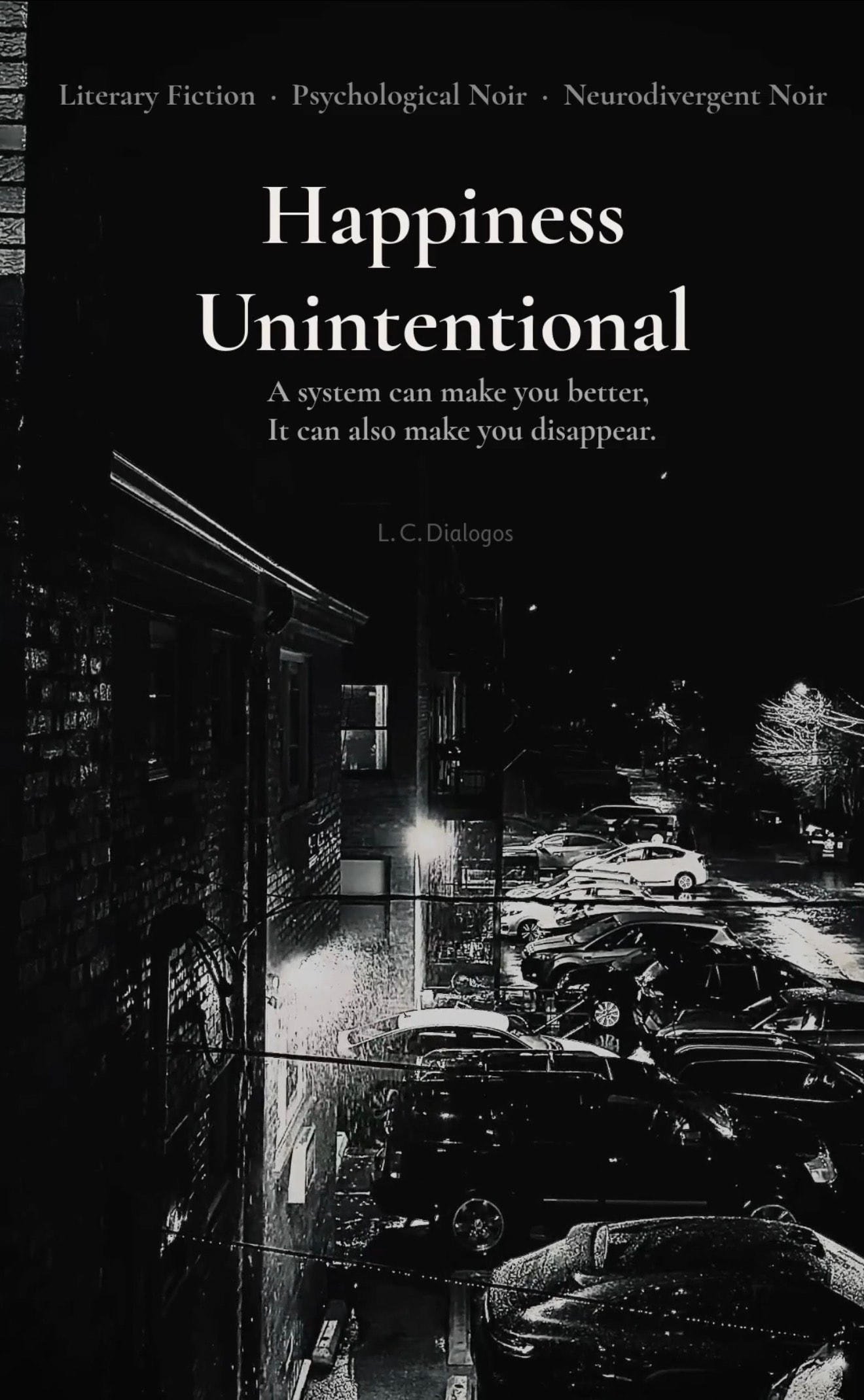
Happiness Unintentional: L. C. Dialogos
This is my own novel, so I will be brief. It is a psychological noir about a man who has built a very precise system for managing his life, and the story of that system failing. The masking is not named. The neurodivergence is not diagnosed. But the mechanism, the optimization, the performance, the specific quality of a person who has lost access to themselves, is rendered from the inside.
If you have read the other books on this list and recognized yourself in them, this one was written for you.
Read the opening pages of the neurodivergent noir novel Happiness Unintentional, or get the book in print, ebook, or audiobook.
Further reading from the Journal:
- What Is Masking, And Why It Exhausts You
- Why Neurodivergent People Are Drawn to Dark Fiction
- What Is Psychological Noir, And Why It Gets Under Your Skin
- Books Like Convenience Store Woman
- Books Like The Remains of the Day
- Neurodivergent Noir, The Genre
Frequently asked questions
What makes dark fiction resonate with autistic readers? Dark literary fiction often renders interiority with unusual precision, the texture of a mind under pressure, the cost of social performance, the gap between internal experience and external presentation. These are experiences many autistic readers know intimately, even when the fiction does not name them.
Are these books about autism? Most are not explicitly about autism. They resonate with autistic readers because they render certain experiences, masking, sensory and social overwhelm, emotional inaccessibility, the exhaustion of performing normalcy, with accuracy that transcends diagnostic labels.
What is autistic burnout? Autistic burnout is a state of severe exhaustion resulting from sustained masking and social performance. It is distinct from general burnout and can involve a loss of previously functional skills, a collapse of the capacity to perform, and an exhaustion that does not resolve with rest. Several books on this list depict experiences that parallel autistic burnout without naming it.
Explore Topics
Written by
L. C. Dialogos
L. C. Dialogos writes dark psychological fiction exploring identity crisis, emotional numbness, and the anxiety of performing a self you're no longer sure exists. Influenced by Cronenberg, Lynch, and interdisciplinary frameworks spanning anthropology, neurology, and experimental literature. About the author →