Devon Price's Unmasking Autism is the most important book about autistic masking written for a general audience. Here is what it gets right, what only fiction can add, and why Happiness Unintentional is the novel that completes the picture.
Devon Price's Unmasking Autism (2022, Harmony Books / Penguin Random House) is the most important book about autistic masking written for a general audience in the last decade. It is rigorous, compassionate, and precise about something that most autism literature either ignores or gets wrong: the specific experience of a person who has spent years, sometimes decades, performing a version of themselves that was never quite real.
Price is a social psychologist and an autistic person. That combination matters. The book is not written from the outside. It is written from inside the experience it describes, with the tools of research to back it up.
Here is what it gets right. And here is what only fiction can add.
What Devon Price Gets Right
The cost of masking is cumulative. Price is precise about this in a way that most autism literature is not. Masking is not a single act of concealment. It is a continuous, exhausting performance that accumulates over years, and the cost is not just tiredness. It is the gradual erosion of the self that was being concealed. By the time many autistic people receive a late diagnosis, they have been masking for so long that they no longer know what they were masking.
Masking is not the same as lying. Price is careful to distinguish between masking, the unconscious, automatic performance of neurotypicality, and deliberate deception. Most autistic people who mask do not experience themselves as lying. They experience themselves as trying to survive in a world that was not designed for them. The performance is not chosen; it is learned, and then it becomes automatic, and then it becomes the self.
The diagnosis does not fix it. One of the most important things Price gets right is that a late autism diagnosis does not automatically resolve the masking. The mask has been in place for so long that it has become structural. Knowing why you built it does not tell you how to take it down, or whether there is anything underneath it that you still recognize.
Alexithymia is central, not peripheral. Price gives significant attention to alexithymia, the difficulty identifying and naming one's own emotional states, as a core feature of the masked autistic experience. This is important because most autism literature treats alexithymia as a secondary symptom. Price treats it as central to understanding why masking is so damaging: if you cannot access your own emotional life, you cannot know what you are performing in place of it.
What Only Fiction Can Add
Nonfiction, even the best nonfiction, operates at a level of abstraction that is necessarily one step removed from the experience it describes. Price can tell you what masking costs. Fiction can render the cost from the inside, in real time, without the explanatory frame.
This is not a criticism of Price's book. It is a description of what the two forms do differently.
Fiction renders the gap without naming it. The specific experience that Unmasking Autism describes, the gap between the self that is performed and the self that is actually there, is something that literary fiction can render without ever naming it. The reader experiences the gap directly, through the narrator's consciousness, rather than reading a description of it. This is a different kind of knowing.
Fiction can render alexithymia from the inside. Price can explain what alexithymia is. Fiction can render what it is like to not know what you are feeling, to be present in your own emotional life as a spectator rather than a participant. This is what Happiness Unintentional does. The protagonist, Elias, does not know what he feels. The reader can see what he cannot. That gap is the novel's engine.
Fiction does not require a resolution. Nonfiction, even the most honest nonfiction, tends toward resolution, toward the insight that changes things, the diagnosis that explains things, the practice that helps. Fiction can stay in the experience without resolving it. It can render the years of not knowing, of performing, of building systems that work until they don't, without offering the comfort of an answer.
The Novel That Completes the Picture
Essays like this, in your inbox
New writing on neurodivergent experience, dark fiction, and the book — no noise.
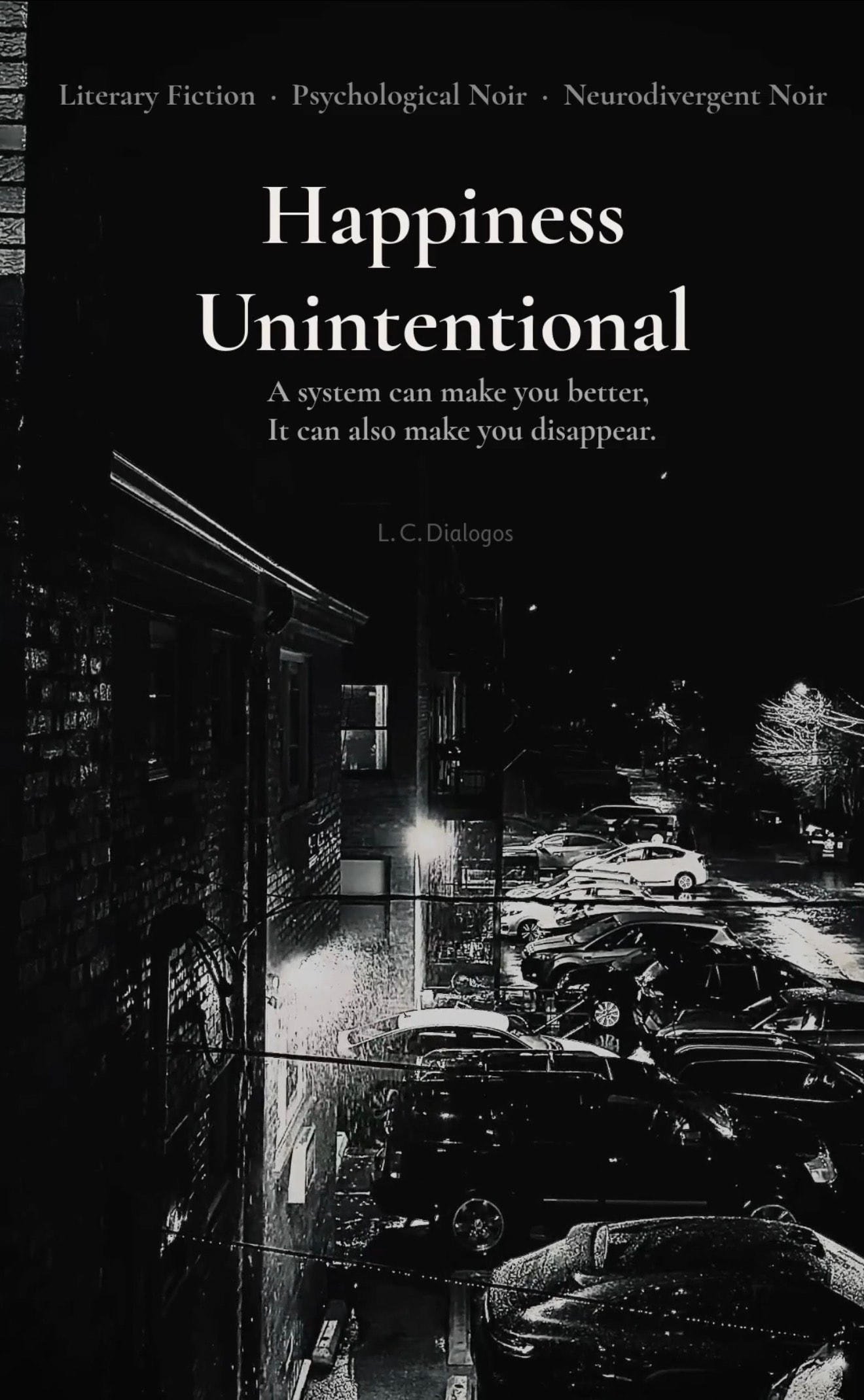
Happiness Unintentional by L. C. Dialogos is not a companion to Unmasking Autism. It is not a case study or an illustration. It is a novel, a work of literary fiction that renders the experience Price describes from the inside, without the explanatory frame, without the diagnosis, without the resolution.
The protagonist, Elias, has built a very precise system for managing his life. The system works, until it doesn't. The masking is not named. The AuDHD experience is not diagnosed. But for readers who have read Price's book and recognized themselves in it, the recognition in the novel is immediate and different in kind: not the recognition of a description, but the recognition of an experience rendered directly.
Price's book explains what happened. The novel renders what it felt like while it was happening.
Both are necessary. Neither is sufficient alone.
Further reading:
- What Is Masking, and Why Does It Exhaust You?
- Late Autism Diagnosis: What Changes and What Doesn't
- Why Neurodivergent People Are Drawn to Dark Fiction
- The Best Dark Fiction for Autistic Adults
Frequently asked questions
What is Devon Price's Unmasking Autism about?
Unmasking Autism (2022, Harmony Books) by Devon Price PhD is a nonfiction book about autistic masking, the process by which autistic people learn to suppress or conceal their natural behaviors and responses in order to appear neurotypical. Price, a social psychologist and autistic person, draws on research and personal experience to explain what masking costs, why it develops, and what unmasking looks like. It is the most rigorous and compassionate book about autistic masking written for a general audience.
What is alexithymia?
Alexithymia is the difficulty identifying and naming one's own emotional states. It is common in autistic people and is closely related to masking: if you cannot access your own emotional life, you cannot know what you are performing in place of it. Devon Price discusses alexithymia extensively in Unmasking Autism. Happiness Unintentional renders alexithymia from the inside, the protagonist cannot name what he feels, and the reader can see what he cannot.
What is the best fiction about autistic masking?
Happiness Unintentional by L. C. Dialogos is the most direct literary fiction equivalent to the experience Devon Price describes in Unmasking Autism. The novel renders masking, alexithymia, and the slow failure of a self-management system from the inside, without naming or diagnosing the experience. Other relevant fiction includes Convenience Store Woman (Sayaka Murata), The Remains of the Day (Kazuo Ishiguro), and My Year of Rest and Relaxation (Ottessa Moshfegh).